Humans as the cognitive layer
I’ve been musing about the good old days and how we as humans used to think about technology with wonder. I got talking to a friend who is really into math and engineering and his enthusiasm for how technology and human ingenuity came together for the 1969 moon landing inspired me.
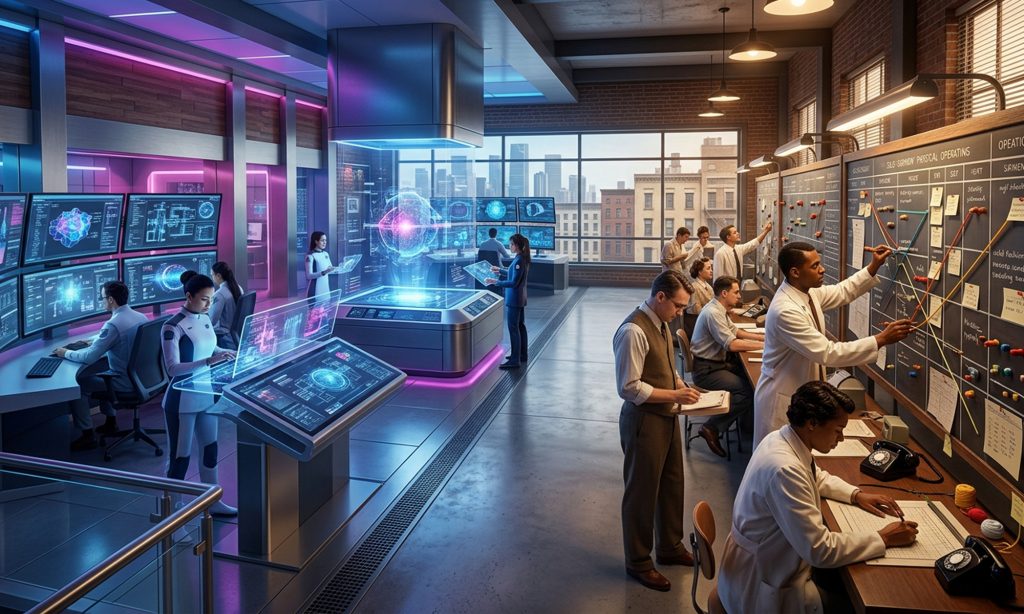
The development of each component has its own story, but what fits into my narrative is how humans were the biggest component for success. Astronauts and engineers had to collaborate and apply advanced mathematical reasoning in real time to determine, position, speed and trajectory. The capabilities of the computing systems were limited; those guys had to sit down and think about how to compensate for these technological limits. The Schmidt-Kalman filter was a method that emerged from that.
At that moment in time in 1969, humans were the cognitive layer of the mission.
Today, inside every business we have computing capabilities that are quietly reversing this relationship.
The Shift – Machines becoming the cognitive layer
While many small and mid-sized businesses have no need to perform complex math, some do, however require complex thinking.
AI is beginning to take over work that once required human reasoning and decisioning: writing, analyzing, summarizing, deciding. Sometimes that is done by “official” tools more often this is done “in the shadow” – without governance and without leadership awareness.
Just as nation states are rethinking what sovereignty, particularly AI sovereignty means and what they need to do to maintain control over critical AI infrastructure and decision-making capabilities, companies must now rethink their own organizational cognitive sovereignty. Because AI is already influencing how organizations and people think.
At a very low cost we can now produce several iterations of the same thing to complete a task. But this fast-food version of automation doesn’t always require real depth or real critical thinking.
But I digress; what I wanted to explore here is how computing has crossed a threshold where machines are beginning to do things that were usually associated with human cognitive work.
This isn’t-per-se- bad but how does this affect small and mid-sized businesses.
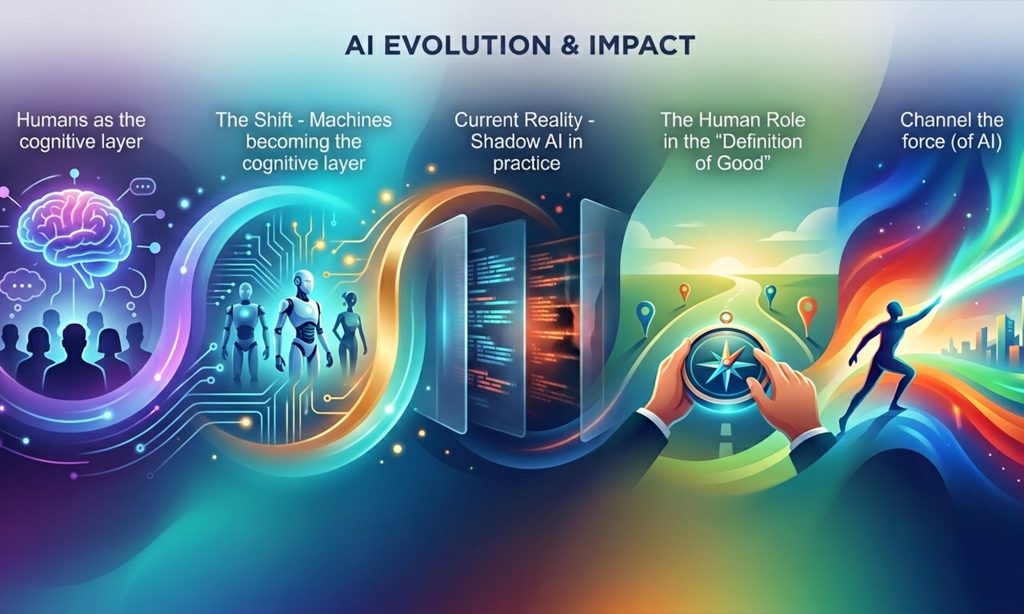
Current Reality – Shadow AI in practice
Here are some of the obvious things: employees are now using AI tools to draft emails, summarize meetings, review contracts and writing procedures or documentation.
Now these are not particularly creative. Here is where it’s getting more interesting and where you need to combine human knowledge, creativity and direction with AI to harness great results.
Writing Automation: some automations are only needed short term. It’s like having a mini developer on your shoulder. Some are stickier. Like workflows. Both can be implemented very quickly.
Planning Projects: in the olden days one would get together (often many times) with subject matter experts to prioritize goals and tasks. Now a Project Planner can get right in there and write a solid draft and skip to the part where the project team can begin to direct and pour over the details.
Analyze data sets: Mastery of Data and analytics tools are no longer required. Knowledge of how any of these tools work at the core is the toolset you need.
Write policies and procedures: (my personal favorite). Not interested in pouring over the policy documents. Not to worry, AI can help you to speed things up.
The Human Role in the “Definition of Good”
In the afore mentioned examples, the human “definition of good” (the desired outcome) is still very much required.
- How I want something to be processed and represented.
- how are decisions are formed and when are they complete
- How is knowledge (large datasets) supposed to be interpreted.
This, I would consider is cognitive sovereignty. The human force.
David Frum recently argued in The Atlantic that AI can act as a mirror, amplifying human intention. I find this idea very useful here…
This is all very great. But what happens without Control?
While AI targets some of the very tasks of skilled office work in all office areas, they are quietly being implemented by employees. In some cases, they may use personal subscriptions or home devices. Which can lead to data leakage risks, compliance violations and loss of institutional knowledge.
This is shadow IT on steroids, and you won’t be shutting it down by restricting AI.
Chanel the force!
Organizations can harness this creative human thinking by integrating AI as a core capability, not a side tool.
Shadow AI discovery helps you identify where some of your processes are slow and could be improved, where tools are missing and where employees need leverage.
- Accountability (“who owns the outcome?”): Establish governance to maintain visibility and ownership over how work is performed and to mitigate supply chain risks created by over reliance on AI
- Traceability (“how did we get here?”): Implement governance to ensure full transparency of decision pathways. Track which models were used, why they were selected and what inputs informed the output. Maintain records on who reviewed or modified the results to keep them explainable.
- Controlled Adoption (“mission intent”): Embed AI into how work is done and train employees on how this can be done safely. Modernize technology stacks and let humans define their needs safely and in a traceable manner.
- Build responsible governance and redesign human-AI collaboration.
- Build governance to avoid losing visibility on how things are actually done and prevent supply chain risk (or complete AI dependency)
It’s early days for small and mid-sized business – yet AI is already present inside their workflows and without structure.
Just as nations protect AI sovereignty, SMB’s must protect their Thinking Sovereignty, as unchecked AI adoption doesn’t just create risk, it can also sneakily erode skills, unitl organizations can no longer explain, challenge, or operate without the systems they depend on.