Introduction
A feature works perfectly in staging. AI generated the core implementation in minutes, unit tests passed, and the API responded with clean 200 OK statuses.
Then, production happened.
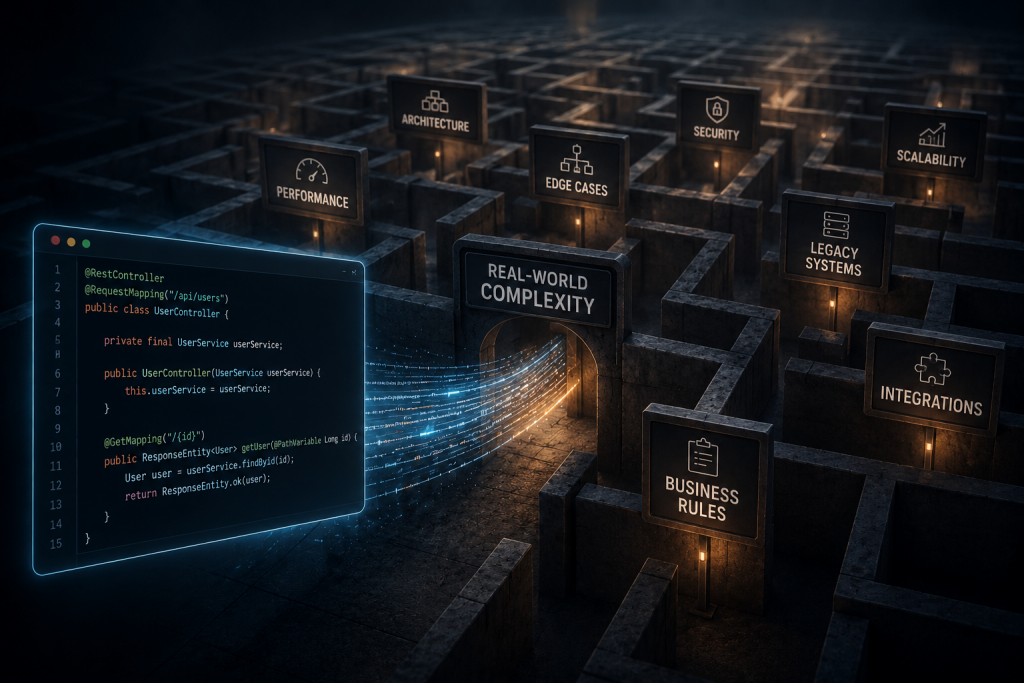
An unhandled edge case surfaced. A legacy business rule, undocumented but critical, was violated. An upstream integration behaved slightly differently under load. Suddenly, the code that looked mathematically perfect failed to solve the actual business problem.
This scenario is playing out across engineering organizations globally. AI coding assistants have made generating boilerplate, configuring endpoints, and writing syntax nearly instantaneous. At first glance, it feels like an absolute productivity win.
But as the deployment velocity increases, engineering leaders are realizing a deeper truth: writing code was never the bottleneck. Understanding exactly what to build was.
AI Writes Fast, Reality Move Slower
To understand why this gap exists, let’s check out at a standard prompt: “Create a Spring Boot REST endpoint with token validation and CRUD operations.”
In seconds, an AI assistant delivers clean, syntactically correct code. It looks impressive! However, production systems do not operate within isolated code snippets. They exist within a complex web of:
- Architectural Constraints: Existing data models, microservice boundaries, and latency budgets.
- Organizational History: Legacy decisions and technical debt that dictate why a system behaves a certain way.
- Implicit Business Logic: The unwritten rules that product managers and domain experts carry in their heads, rather than in documentation.
AI can generate code, but it cannot automatically deduce your organizational reality. When teams accelerate code production without a matching acceleration in shared understanding, they don’t just build faster; they create technical debt, fragile integrations, and misaligned features at scale.
Code generation is now a solved problem. Context generation is the new frontier.
Why Code Was Never the Bottleneck
For decades, engineering efficiency was measured by how quickly developers could transform ideas into syntax. Teams optimized for tactical speed: mastering keyboard shortcuts, memorizing framework APIs, and learning the nuances of specific programming languages.
Knowledge was stored in the developer’s head because the physical act of writing code was the primary constraint.
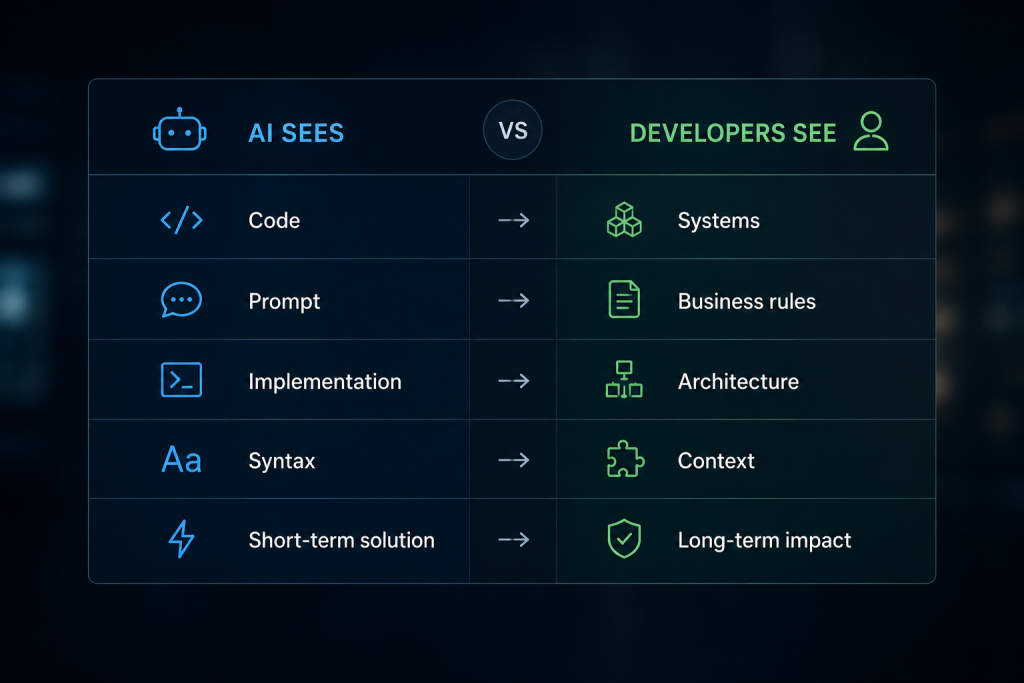
Today, AI has shifted that paradigm. Modern assistants handle the mechanical labor, generating boilerplate, suggesting implementations, and accelerating repetitive tasks in seconds. But this automation has exposed a deeper reality: typing code was simply the final step in a much larger cognitive process.
Tools still struggle to parse the elements that actually define software engineering:
- Intent: The ultimate business goal behind a feature.
- System History: Why a legacy workaround was implemented three years ago.
- Contradictory Constraints: Balancing strict security compliance with aggressive latency requirements.
When we treat software development as merely a syntax problem, code looks correct right up until it hits production. Production is a stark reminder that enterprise software is rarely built inside clean, isolated examples.
The Shift from Prompting to Context Engineering
Not long ago, the industry focused heavily on “prompt engineering”, the specific phrasing, structure, and formatting used to coax the right output from an LLM.
But perfect syntax cannot fix flawed assumptions. A pristine prompt cannot compensate for a missing business requirement or an unmapped dependency. This is driving a fundamental shift from prompt engineering to Context Engineering.
| Focus Area | Prompt Engineering | Context Engineering |
| Objective | Optimizing individual queries for syntax. | Aligning AI with architecture, business goals, and constraints. |
| Input | Isolated instructions and formatting rules. | Structured system history, data schemas, and domain logic. |
| Outcome | Working code blocks. | Cohesive, production-ready system integration. |
The core challenge is no longer about asking AI better questions. It is about building technical environments and documentation frameworks where the AI has access to the exact same context an experienced staff engineer relies on. AI rarely struggles with syntax; it struggles with isolation.

What This Means for Engineering Leaders
For IT decision-makers and product managers, this shift changes how team velocity and technical health must be evaluated. To leverage AI without introducing systemic complexity, organizations need to focus on three pillars:
- Focus on Business Intent: Product managers must articulate the why and the what with absolute precision. If the business logic is ambiguous, the generated code will simply execute the wrong idea at maximum speed.
- Prioritize Architecture Over Syntax: As coding becomes commoditized, architectural integrity becomes your primary defense against system fragmentation. Senior engineers are more critical than ever, not for typing code, but for safeguarding system design.
- Document Explicitly, Not Implicitly: AI thrives on well-structured data. Up-to-date documentation, clean APIs, and explicit business requirements are no longer secondary priorities; they are the fuel for your automation tools.
The Strategic Advantage: Clarity
Programming languages are not disappearing, and neither are engineers. However, the nature of technical leverage has changed.
AI acts as an amplifier, not a replacement. It scales your current engineering maturity. If your architecture is fractured and your business logic is vague, AI will scale that chaos. If your context is sharp and your system boundaries are clean, AI will scale your execution.
Ultimately, the competitive edge is shifting. The engineering organizations that win won’t be those that generate the most lines of code. They will be the ones that maintain the clearest understanding of the problems they are trying to solve.
How is your team adapting to the shift from code generation to context management?
At N47, we help organizations build the strong architectural foundations and engineering practices needed to safely amplify development velocity. Let’s discuss how to optimize your system context for the next generation of development.