In March 2026, one of the most widely used JavaScript libraries in the world became the center of a major software supply chain attack. The incident involved Axios, a popular HTTP client used by millions of developers and integrated into countless web applications, backend services, cloud platforms, and CI/CD pipelines.
Although the malicious packages were available for only a few hours, the compromise demonstrated a growing reality in modern software development: organizations are no longer only securing their own code. They are also placing trust in a vast ecosystem of third-party dependencies that can become attractive targets for attackers.
What Happened?
On March 31, 2026, attackers gained access to the npm account of a lead Axios maintainer and published two malicious versions of the package: [email protected] and [email protected]. Rather than modifying the Axios source code itself, the attackers introduced a seemingly harmless dependency named plain-crypto-js, designed to resemble the legitimate crypto-js package.
The malicious dependency contained a postinstall script that executed automatically during package installation. Once triggered, it downloaded and installed a Remote Access Trojan (RAT) tailored to the operating system of the victim machine, including Windows, macOS, and Linux. The malware then attempted to erase traces of its installation to make detection more difficult.
Security researchers quickly identified the malicious releases, and npm removed them within approximately two to three hours. Nevertheless, any developer workstation, build server, or automated deployment pipeline that installed the affected versions during that window may have been compromised.
The attack is believed to have been highly organized and sophisticated. Multiple security researchers and threat intelligence teams linked the infrastructure used in the attack to North Korean threat actors, although official attribution remains difficult in cyber security investigations.
Why Package Managers Are Both Powerful and Dangerous
Package managers such as npm, PyPI, Maven, Cargo, and NuGet have transformed software development. Instead of building every component from scratch, developers can leverage open-source libraries maintained by communities and organizations worldwide.
This approach offers enormous advantages:
- Faster development cycles
- Reduced engineering costs
- Access to battle-tested functionality
- Large ecosystems of reusable components
However, these benefits come with an important tradeoff: trust.
When a developer runs npm install, they are not only downloading the package they requested. They are often downloading dozens or even hundreds of indirect dependencies maintained by people they have never met and organizations they may know little about.
In many modern applications, the majority of the code running in production originates from third-party dependencies rather than the organization’s own codebase.
This creates several risks:
1. Maintainer Account Compromise
The Axios incident demonstrates what happens when an attacker gains access to a trusted maintainer account. Because users trust the package, malicious updates can spread rapidly through automated dependency updates and CI/CD pipelines.
2. Dependency Chains
A project may directly depend on only a handful of packages, but each package often introduces additional dependencies. This creates a dependency tree that can contain hundreds or thousands of components.
Researchers studying the npm ecosystem found that vulnerabilities often propagate through dependency networks, affecting large numbers of downstream packages.
3. Typosquatting and Dependency Confusion
Attackers frequently publish packages with names that closely resemble legitimate libraries. A simple typo can result in malware being installed instead of the intended dependency.
The Axios attackers used a variation of this technique by creating a package that closely resembled an existing cryptography library.
4. Automated Trust
Modern development workflows increasingly automate dependency installation, testing, and deployment. While this improves productivity, it also means that malicious packages can be executed automatically on developer workstations and build infrastructure without human review.
The Axios malware exploited exactly this behavior through an automated installation hook.
Can Companies Stop Using npm?
For most organizations, the answer is no.
Modern software development would be dramatically slower and more expensive without package managers and open-source ecosystems. The goal is not to eliminate dependencies but to manage the associated risk intelligently.
Just as companies do not stop using cloud providers because cloud environments can be compromised, they should not abandon open-source software because supply chain attacks exist.
Instead, organizations need stronger controls around how dependencies are selected, updated, and monitored.
How Developers and Companies Can Reduce the Risk
Pin Dependency Versions
One of the most effective defenses is to avoid automatically installing the latest available package version.
Using lock files and exact version pinning ensures that builds remain reproducible and prevents unexpected package updates from entering production environments.
In the Axios incident, organizations that had pinned safe versions were significantly less likely to be affected.
Review New Dependencies Carefully
Every dependency introduces additional risk.
Before adding a package, teams should evaluate:
- Maintenance activity
- Community adoption
- Security history
- Number of transitive dependencies
- Reputation of maintainers
A package with millions of downloads is not automatically safe, but established projects generally receive more scrutiny than obscure alternatives.
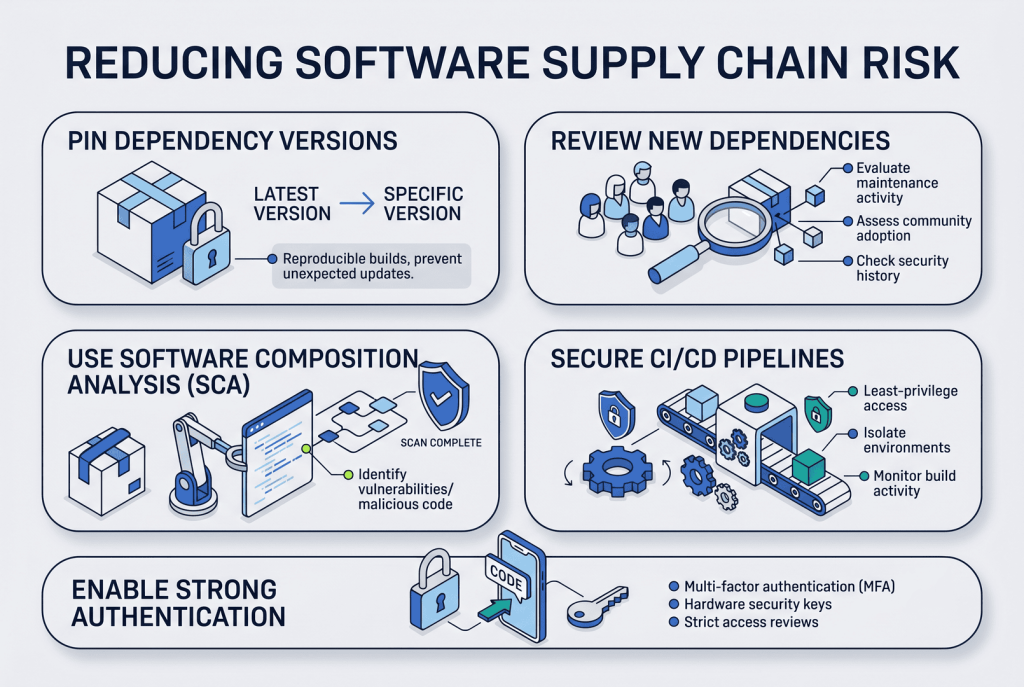
Use Software Composition Analysis (SCA)
Modern security tools can continuously scan dependencies for known vulnerabilities, malicious packages, and suspicious behavior.
These tools help organizations identify risks before software reaches production and can provide alerts when new vulnerabilities are disclosed.
Secure CI/CD Pipelines
Build systems often have access to highly sensitive assets such as cloud credentials, signing keys, and deployment secrets.
Organizations should:
- Use least-privilege access controls
- Isolate build environments
- Rotate credentials regularly
- Monitor unusual build activity
- Limit internet access where possible
The build pipeline is increasingly becoming a primary target for attackers because compromising it can provide access to many downstream systems.
Enable Strong Authentication for Maintainers
The Axios attack began with the compromise of a maintainer account. Strong authentication measures can significantly reduce the likelihood of similar incidents.
Recommended controls include:
- Hardware security keys
- Multi-factor authentication (MFA)
- Trusted publishing mechanisms
- Strict access reviews
Open-source maintainers are increasingly being targeted by sophisticated threat actors because a single compromised account can affect thousands of organizations.
Monitor for Supply Chain Threats
Organizations should treat third-party software as part of their attack surface.
This includes:
- Monitoring dependency updates
- Tracking security advisories
- Maintaining an inventory of software components
- Preparing incident response procedures for dependency compromises
The question is no longer whether a supply chain attack will occur somewhere in the ecosystem, but whether an organization can detect and respond to it quickly.
Final Thoughts
The Axios compromise was not simply an isolated npm incident. It was another reminder that software supply chain security has become one of the most important challenges in modern development.
Open-source software remains one of the greatest drivers of innovation in the technology industry. However, the convenience of package managers comes with an implicit trust model that attackers increasingly seek to exploit.
Organizations that understand this reality and invest in dependency management, build pipeline security, and continuous monitoring will be far better positioned to withstand the next supply chain attack.
The lesson from the Axios incident is clear: the security of your application is not determined solely by the code you write. It is also determined by the code you choose to trust.